Bioethics Forum Essay
Don’t Settle for Plastic Flowers: New Report on What It Means to Stay Human
The American Enterprise Institute (AEI) recently launched an AI ethics council, modeled on the President’s Council on Bioethics. Leon Kass, senior fellow emeritus at AEI and a Hastings Center Fellow, chaired the President’s Council from 2001 to 2005, and this new council’s first publication, “Offloading Ourselves: An Inquiry into Staying Human in the Age of AI,” reflects Kass’s interest in the question of what it means to be – and to stay – human.
In my research, I am exploring the current and future role of AI in aging and caregiving, including how our evolving concepts of AI ethics and our sociotechnical imaginaries about AI account for these human experiences. I was interested in what this report might offer on how to think about a social phenomenon that, like the Red Queen’s Race in Through the Looking-Glass, feels ever “Faster! Faster!” (Disclosure: The report’s principal author, Brian J. A. Boyd, invited me to provide comments on a draft; I was not involved in the final consensus document.)
The report’s deepest concern – prompted by “the jarring experience of encountering an uncanny technology that mirrors us, imitates us, and in some ways surpasses us” – is that we humans should have “a better grasp of the answer to “‘Who are we, and who do we hope to become?’”:
“In a pluralistic society, that ‘we’ will have many different forms. Yet there are shared concerns that arise from our shared human nature. Asking the right questions leads not to a single set of right answers, but to a set of ways in which we might understand ourselves and our goals, and thus a perspective from which we can see paths forward.”
The introduction offers five “presuppositions and background beliefs” that reflect consensus among council members and shape the discussions that follow. These are the importance of habits in moral life; relationality and embodied care; a vision of the good; opposing “expressly transhuman or posthuman ideologies,” and recognizing that society’s shift “from literate to digital cultures” predates the arrival of publicly available chatbots and is accelerated by ever-deepening habits of using and relying on AI. (Faster! Faster!)
These presuppositions are useful reminders of what it’s like to be alive right now, to be aware of developing habits of turning to chatbots with a range of queries; to be frustrated when trying to communicate with a chipper AI customer care rep; to be curious about whether a social robot could be a good-enough companion or caregiver; to know that, once a widely-used social technology has arrived, there is no going back. (See: the telephone, radio, television, the internet, email, smartphones, social media.) We have – and we have not – been here before.
The report’s six sections each pose a question. The first two encourage us to reflect on how embracing AI as a hack to a faster, smarter, and more efficient self involves trading away the habits that enable us to learn a new skill or experience the fun of thinking. There are examples of how AI is shaping education, with distinctions between what AI tools can do to advance scientific research (see AlphaFold) and the human work of learning to think like a scientist. There are also distinctions between education that creates “free citizens with a commitment to independent thought” and “utilitarian, machine-powered schooling” that will ensure its graduates remain slaves to the machine they cannot do without.
Rebecca Winthrop, director of the Center for Global Education at Brookings, wrote in a New York Times essay that while she is a “big fan” of tech, she makes a sharp distinction between using an AI as a specialist tool and offloading human capacities for brainstorming and other creative work onto a chatbot. Like the authors of this report, she argues for recognizing human creativity as “something to protect and nurture.” Other sections of the report consider the effects of offloading memory, shared understanding, agency, and love onto AI in ways that may be convenient and frictionless, but render us both less independent and less capable of interdependence with fellow imperfect humans.
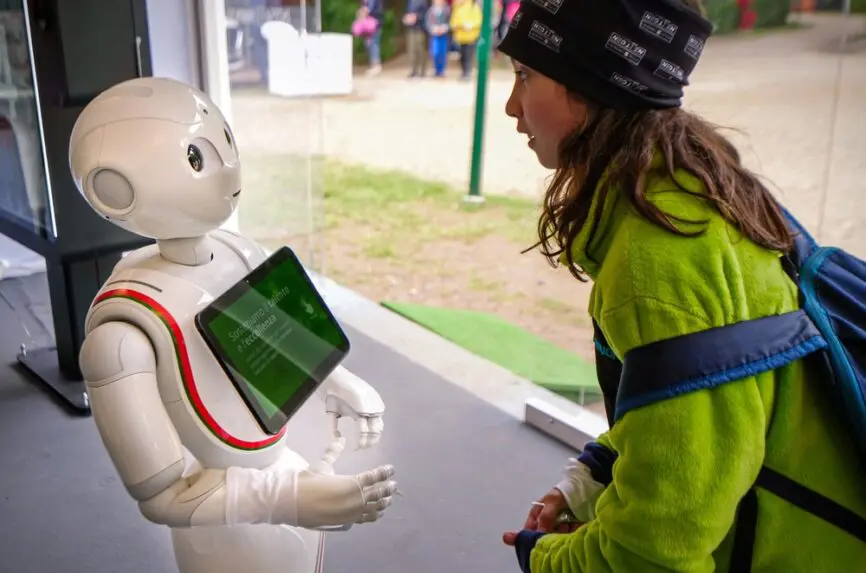
The section on care considers how our growing habits of engaging with AI may make us impatient with each other and the demands of care. Robots don’t get bored, tired, or burned out. What moral and political philosopher Alasdair MacIntyre termed “plastic flower syndrome” – the replacement of human touches with simulacra, such that we become accustomed to the representation of a flower, surprised by a real one – is applied to the creep of generative AI into human domains. I’m now surprised when I learn that the voice on the other end of a customer care call is (for now) human. And yet, I also appreciate that a human designed an AI to demonstrate empathy, a human virtue not always evident in human behavior or institutions.
After reading this thought-provoking, jargon-free, and useful report, illustrated with striking black and white photos of humans, I checked which reports were published by the Kass-era bioethics council. There were the hot-button issues of the day – cloning, stem cells – associated with debates about the beginning of life. That’s how I remembered that era, until I got an AI assist. (Thanks, Gemini!) “Staying Human” calls back to Being Human (2004), a report that also aimed to support discussion about shared experience. Taking Care (2005) had “aging society” in its subtitle, encouraging bioethics to look beyond the clinical to the social. I appreciate how this new council connects past work in bioethics to challenges we’re facing today. When it comes to the dual social phenomena of population aging and of AI, we’re all in this together, and should encourage the habit of thinking together.
Nancy Berlinger, PhD, is a senior research scholar at The Hastings Center for Bioethics. Her research focuses on ethical and social challenges of population aging (Bioethics for Aging Societies).











As an older person it would be just awful in my opinion to have a robot carer with fixed glassy eyes and robotic speech, I think this would be inappropriate even if dementing. Hoping there will be some input from the likely consumer and consent for this delegated care from the person or their surrogate.
Thank you for your comment! Designers and developers of social robots for caregiving roles share your interest in what a robot should — and should not — look like, and in what older adults themselves think about social robots. Some teams involve older adults in the design process itself. Consent is important concerning a person’s health information, and also because a robot shares space with a person and may be designed to sense their presence and initiate conversation — what can the user control about this experience of living with a robot? As these devices may be marketed directly to older adults or to caregivers, these questions are important for all of us to think about.