Bioethics Forum Essay
They Volunteered to Get Hepatitis
“I’m not willing to kill for my country—but I am willing to die for it.” So spoke a so-called “Conchie,” a conscientious objector who volunteered to participate in medical experiments during World War II as a way to avoid military service.
Well, maybe he said that. The quote comes from a new book, Infected for Science. Although written by Sydney Halpern, a historian of medicine, the book is a graphic novel that uses fiction and drawings to tell the story of a group of conscientious objectors who were given active hepatitis virus so the military could learn more about the disease in actual soldiers.
At a time when concern for public health—and sacrificing for others—may be at their lowest ebb, Infected for Science is a fascinating throwback to an earlier, more communitarian America. How did injecting hepatitis into healthy individuals become a sanctioned activity? And is altruism in the name of public health still a viable option?
Why did Halpern write a graphic novel? First, she wrote a traditional historical book on the topic: Dangerous Medicine: The Story Behind Human Experiments with Hepatitis. But during her research, she stumbled on a fascinating trove of documents—drawings made by one of the conscientious objectors during his time as an experimental subject in New Haven, Connecticut in 1945. David H. Miller was an aspiring artist from Los Angeles when he was drafted in 1942 at the age of 23. Infected for Science is a fascinating mix of Miller’s cartoons, which appear in blue, and those of Trygve Faste, an artist who collaborated with Halpern and drew the cartoons that tell the story of Miller and his fellow conscientious objectors.
As a member of the Brethren Church, Miller was a pacifist and thus applied to be a conscientious objector. The Selective Service approved his request and assigned Miller to the Civilian Public Service (CPS), sending him to various Forest Service Camps. However, he grew bored cutting down trees and applied for the hepatitis study. “It seemed like a project that would make a difference,” Miller states in the book. “I applied and I got in.”
So, did Miller actually say that? In an email, Halpern said that, in addition to the drawings, she unearthed a large amount of archival material about the New Haven site and other CPS experiments. This information enabled her to give her fictional characters considerable veracity.
Human experimentation is a common topic in both the history of medicine and bioethics. Among the best-known episodes are the horrific experiments carried out by the Nazis against Jews and other prisoners in concentration camps; the secret removal of cancer cells from a Black woman named Henrietta Lacks for medical research that would prove extremely important; and the Tuskegee Study of Syphilis of Untreated Syphilis in the Negro Male, in which Black men with syphilis were deliberately and deceitfully left untreated.
But the ethical issues in human experimentation come to life in Infected for Science, depicted so vividly in Faste’s images and Halpern’s fictionalized story of David Miller. Is it ethical to potentially cause harm—even death—to research subjects if they truly volunteer? And how can one ensure that the consent given is genuinely informed—and not coerced?
On February 16, 1945, shortly after Miller arrived in New Haven, the scientists running the study made a presentation to the 27 volunteers and answered their questions. Hepatitis was rampant in the military, they explained, and a major cause of disability among soldiers. They believed that there were two strains of the virus and hoped that by infecting healthy subjects with virus obtained from soldiers, they could learn about the transmission of the disease and the various types of illness it caused. Symptoms of hepatitis, Miller learned, included nausea, vomiting, fever, exhaustion, and jaundice. “The death rate,” one of the scientists is quoted as saying, “is about one in a thousand cases.”
So, it seems as if Miller and his colleagues knew what they were getting themselves into. None of the 27 backed out. But the consent form made the volunteers uneasy, releasing the army and the researchers from any liability.
In the first experiment at New Haven, begun in March 1945, doctors gave hepatitis to the volunteers in two ways: mixed into a chocolate shake and by injection. Then came the waiting. Who would get sick? After a few weeks, several of the men, although not Miller, developed the well-known symptoms of hepatitis: fever, fatigue, nausea, vomiting and, in some cases, jaundice. Fortunately, none of the cases proved serious.
There was other good news. On May 8, Germany surrendered to the Allies. But there was still war in the Pacific and researchers were still studying hepatitis. So, beginning in July 1945, Miller and the other Conchies underwent another round of experimentation—this time with more virulent strains of the disease.
Once again, there was good news from overseas. The Japanese surrendered on August 15, 1945. But the experiments were still ongoing. This time, 10 of the men became very ill, necessitating admission to a nearby hospital. A few became so sick that they needed feeding tubes. But at the end, they all pulled through. Halpern believes the CPS experiments were one step toward the eventual development of hepatitis vaccines.
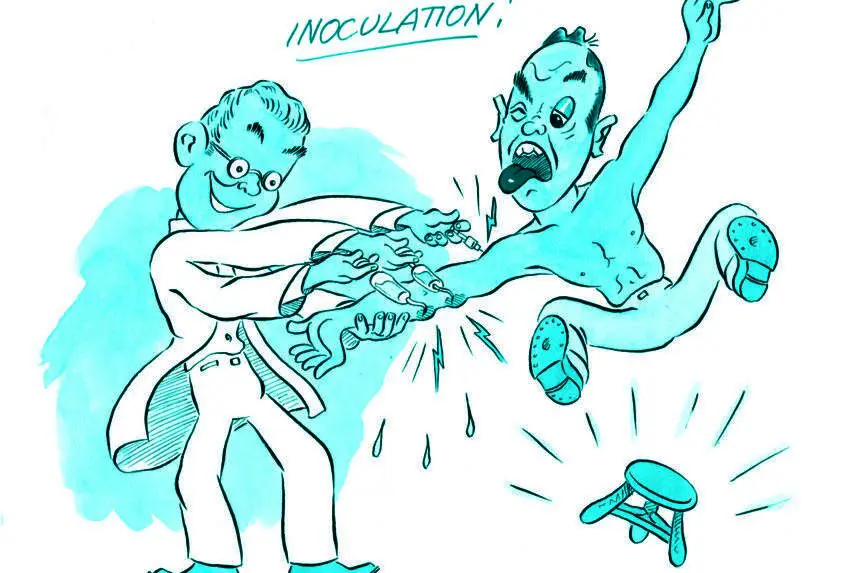
All of these events are dramatically depicted in Miller’s cartoons. In one, entitled “Inoculation,” a doctor is shown gleefully injecting a patient, who is leaping off his chair, with his tongue hanging out of his mouth, presumably in pain. In another, captioned “Jaundice,” this feared complication of hepatitis is characterized as a monster attacking a fleeing subject. Two passersby announce, “Another sucker!” Halpern writes that this sarcasm, a type of gallows humor, helped the Conchies get through a fearful and uncertain experience.
Infected for Science also details some very ethically questionable hepatitis experiments that doctors carried out at this same time in prisons and mental institutions. It turns out that Miller and his fellow volunteers learned about these studies and objected vehemently because they believed the subjects could not have given meaningful informed consent.
So how do we assess the experience of the Conchies? From the vantage point of 2026, the experiments may seem especially surprising. Critics, such as Secretary of Health and Human Services Robert F. Kennedy, Jr., are actively challenging the basic tenets of public health interventions and medical research. Many see the government’s response to the Covid-19 pandemic as heavy-handed and based on poor science. In such a setting, finding people willing to risk their health for the benefit of others seems like a pipe dream.
But it’s hard not to look back on the hepatitis experiments with admiration for the men who willingly volunteered to put their lives on the line for their country. And today, as documented in another new book, Intentionally Infecting Humans: Is it Ethical?, by Hastings Center fellow Seema Shah, there is a robust ethical framework for ensuring that volunteers in vaccine experiments are fully informed and not misled. Hopefully, excellent scientific research, along with the altruism that must accompany it, will continue to thrive.
Barron H. Lerner, MD, PhD, professor of medicine and population health at New York University Langone Health, is the author of The Good Doctor: A Father, a Son and the Evolution of Medical Ethics. He is a Hastings Center Fellow. @barronlerner
[Cartoon by David H. Miller, published in Infected for Science by Sydney Halpern with art by Trygve Faste (Graphic Mundi, 2026)]













ANOTHER VIEWPOINT
By Sydney Halpern
In July 2026, The Hastings Bioethics Forum ran physician-historian Barron Lerner’s review of Infected for Science (Graphic Mundi, 2026), a graphic account of hepatitis-infection experiments conducted during World War II. As one of the book’s co-creators, I’m pleased that bioethicists might learn about the work from a Forum posting. But I would like to clear up misconceptions in the review about both our book and the graphic-narrative form more generally.
Early in his commentary, Lerner questions whether a character in the story—a religious pacifist who participated in hepatitis-infection studies—actually said, “I’m not willing to kill for the country but I’m willing to die for it.” As an endnote in the book confirms, the statement with minimal paraphrasing comes directly from archival documents on real-life participants in the experiments, with the underlying sentiment further substantiated in secondary sources.
Lerner goes on to call the book’s account “fiction,” and ask whether the story’s protagonist really said, of his transfer to the hepatitis research camp: “It seemed like a project that would make a difference. I applied and I got in.” Historical records show that pacifists in the World War II Civilian Public Service (CPS) system—with its more than 150 alternative service camps—had multiple option for postings; CPS assignees had to apply and be admitted to the research units, and quite a few were turned down. An abundance of archival material attests to the stated humanitarian motivations of the men who applied for this work.
One could raise questions of the kind Lerner does about any number of well-regarded graphic accounts of historical events. Did Art Spiegelman’s father really use the phrases and voice all the emotions depicted in the graphic Holocaust story Maus? Were the words exchanged among protestors on the Edmund Pettus Bridge in 1965—and the later sequence of events—exactly as shown in John Lewis’s account of civil-rights activism in March? Authors of historical graphic narratives extrapolate from their deep knowledge of past events to create imagery, dialogue, and text that tell a compelling story. Through sequential art and a modicum of words, they are able to reach audiences unmoved by academic, prose-only accounts. To call graphic history “fiction” is to diminish its contributions to public engagement with, and understanding of, the historical past.
Later in the review, Lerner writes, “Halpern believes the CPS experiments were one step toward the eventual development of hepatitis vaccines.” This greatly distorts what I believe. The facts are that experiments with pacifists in Infected for Science were aimed at determining how hepatitis viruses were transmitted—the investigators were conducting initial studies of the pathogens. Three decades would pass before Baruch Blumberg stumbled upon the antigen for hepatitis B. It was this discovery, by a scientist outside the hepatitis-research community, that made the first hepatitis vaccine possible.
Lerner gets it right when he points to questions the narrative raises: “Is it ethical to potentially cause harm—even death—to research subjects if they truly volunteer? And how can one ensure that the consent given is genuinely informed—and not coerced?” My collaborator Trygve Faste and I intended to tell a morally complex story that provokes discussion of biomedical research ethics. We chose a graphic format with the aim of capturing the interest of a range of audiences. In recent years, both graphic medicine and graphic history have gained momentum and recognition. We hope people in the field of bioethics will be open to these alternative vehicles for presenting past and present truths about health and medicine.
Sydney Halpern, PhD, is Professor Emerita at University of Illinois Chicago and Lecturer in Medical Education, Center for Bioethics and Medical Humanities, Feinberg School of Medicine, Northwestern University. Her books include Dangerous Medicine: The Story behind Human Experiments with Hepatitis (Yale University Press, 2021). http://www.sydneyhalpern.com