Bioethics Forum Essay
Flesh-eating Worms Grab Attention. How Should Attention Affect Policy?
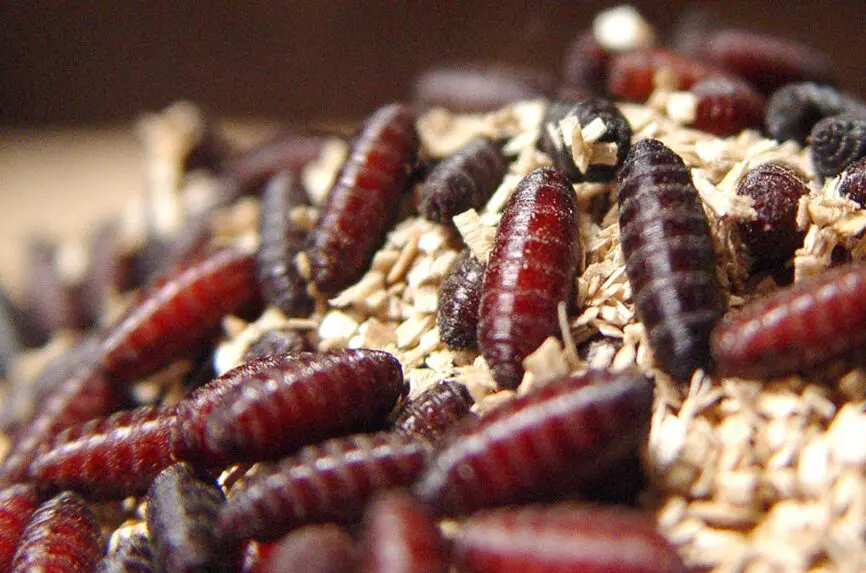
Last week, the New World screwworm, a fly whose larvae feed on the flesh of warm-blooded creatures, opening large wounds that become infected and often lead to death by sepsis, reappeared in the U.S. after a roughly 50-year absence. The flies occasionally attack humans, and the attack is reportedly excruciating—though one hardly needs to know that it’s painful to be thoroughly disgusted by it. I’ve been part of a research project aimed at thinking about whether and how genome editing might be used to help control screwworm, and I’ve found the revulsion that screwworm generates to be a complicated aspect of this thinking.
Screwworms had been eliminated from the U.S. and Central America through a technique that involves sterilizing huge numbers of flies that are then released to mate with fertile wild flies and prevent them from reproducing. This technique is still employed in Panama, at the Darien Gap, creating a fence to prevent them from escaping from their remaining range in South America. But a few years ago, the fence broke down, and flies have been steadily coming north. They’ve now made it across the Mexican border into Texas.
Since the sterile insect technique at the Darien Gap no longer seems to be a great long-term solution, researchers have suggested several other techniques to augment or replace it. One possibility is to enhance the sterile insect technique by using flies that have been genetically modified with a female-killing trait so that female larva will fail to develop. Another is releasing the genetically modified strain without sterilizing it, which would introduce the female-killing trait into wild populations. Yet another is connecting the genetic modification to a gene drive, forcing the female-killing trait to spread through the species in the wild.
Last year, the scholars in this project (I am co-principal investigator with James Collins, an evolutionary ecologist at Arizona State University) argued in an essay in Science that these other techniques are worth consideration. In fact, we argued that it might be reasonable to try to completely eradicate screwworm using these techniques. We called for more study of the environmental consequences and more public debate.
But I have fretted about publishing that argument. Hard cases make bad law. Does a flesh-eating worm really help us think about how to use genome editing in the wild?
One worry here is that any decision to eradicate a species via genome editing, even when there is a strong moral justification for eradication, might open the door to eradication in many other cases where the moral justification is much weaker. This is a version of a slippery slope argument. As a matter of logic, it isn’t compelling; we can simply insist on a strong moral justification. But as a matter of politics, the problem seems very real.
In the U.S., species conservation is enshrined in the Endangered Species Act, one of the signal achievements of the environmental movement. However, the ESA also sets out a mechanism for overriding its species protections: when national security or national interest is at stake, a special committee, colloquially known as the God Squad, can be convened to decide whether to override the ESA. The Trump administration has proposed that this mechanism be used more frequently, and this spring, it invoked it to waive limitations on oil drilling in the Gulf of Mexico that are believed to endanger the nearly extinct Rice Whale.
Further, the reasons for wanting screwworm to go away show how the considerations in favor of species eradication could expand. The moral argument our group identified for screwworm eradication centers on the harm it causes animals in our care—livestock, which, though they may be destined to be slaughtered, depend on our oversight, and should be protected and cared for while they are alive. The fact that the livestock industry across the screwworm’s natural range is worth many billions of dollars was not a key point. But it is not entirely outside the range of moral considerations, either; economic benefit can translate into human well-being, and sometimes, especially in South America, it has been recast in terms of economic self-sufficiency and food security. So, it’s easy to see how the God Squad could end up counting dollars to make decisions about species.
The solution to this problem can really only be to try to keep our eyes on what most matters and strive for a public conversation about the policy response that keys policy to what most matters. There is, however, a further problem underlying this one. How, when something is attention-getting, can we be sure that we really are focused on what matters? When I give talks about the prospect of driving screwworm into extinction, I usually show a couple of pictures of animal flesh infected with screwworms. They are grisly, horrific images. But if part of the moral case is the suffering at stake, an image seems to me to help convey the problem. To understand suffering and weigh it appropriately is, in part, to have the right emotional response to it.
Nonetheless, it is possible to be carried away emotionally by the details of a case. One might, of course, be carried away by details that are irrelevant. The calf is so cute—look at its big eyes! But one can also be carried away by relevant details. One might be swamped by suffering. This is closer to the classic version of the hard-cases-make-bad-law problem.
Part of the response to this problem is to find ways of testing our emotional responses. One can slow down the decision-making, adopt formal deliberative methods that encourage one to think about the case in different ways, and bring in other, possibly alternative perspectives, such as through deliberative public engagement processes. These are all steps that should be taken with the screwworm case.
In the legal system, courts sometimes deal with hard cases by trying simply to avoid having to decide them at all, instead finding ways to dismiss them on procedural grounds. Our group argued, in effect, that simply avoiding the hard cases for how genome modification can be used is not justifiable. Screwworm’s impact is a genuine problem and really does justify at least considering the possibility of full extinction.
Another strategy that courts employ to take on a hard case is to write a narrowly crafted decision. They tailor a decision to the facts of the case and try to avoid setting broad precedents. That, our group argued, is the right approach to decisions for deliberate extinction. Each case must be considered individually. Ultimately, we thought, decisions in favor of extinction, if they happened at all, would probably be very rare. Hard cases should remain hard, not made mundane.
Gregory E. Kaebnick, PhD, is the director of research of The Hastings Center for Bioethics and a Hastings Center Fellow.