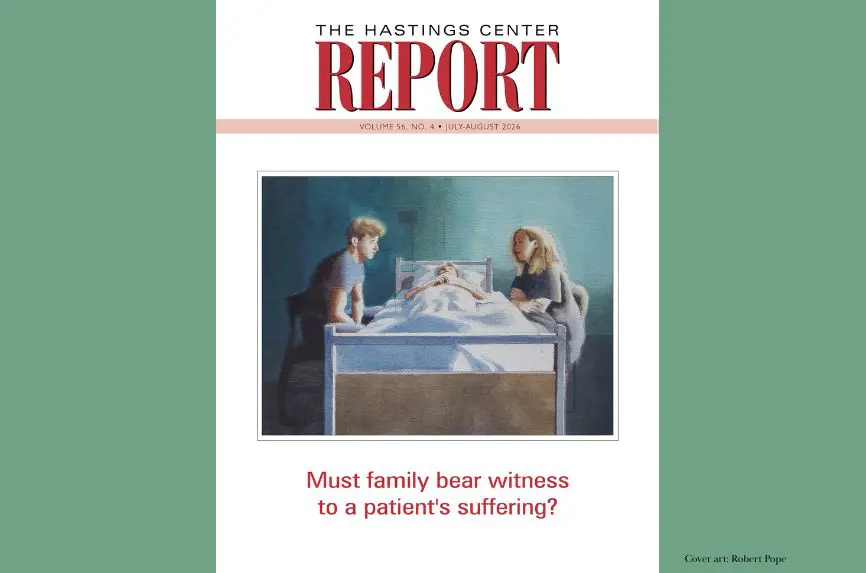
Hastings Center Report







 |  |  |  |
The Hastings Center Report explores the ethical, legal, and social issues in medicine, health care, public health, and the life sciences. Six issues of the pioneering bioethics journal are published each year, containing an assortment of essays, columns on legal and policy developments, case studies of issues in clinical care and institutional administration, caregivers’ stories, peer-reviewed scholarly articles, and book reviews.
To access supporting information for articles in the Hastings Center Report, such as tables, figures, and appendices that do not appear in the journal itself, see this page.
Authors come from an assortment of professions and academic disciplines and bring a range of perspectives and political opinions. We welcome submissions from new authors. The Report’s readership includes physicians, nurses, scholars of many stripes, administrators, social workers, health lawyers, and others.
For permissions, contact Wiley Online Library.
Gregory E. Kaebnick, editor
Laura Haupt, editor
Julie Chibbaro, staff editor
Nora Porter, art director
Contributing Editor
Rebecca Dresser
Editorial Committee
Nancy Berlinger, Virginia Brown, Susan Gilbert, Laura Haupt, Gregory E. Kaebnick, and Julia Kolak
The Hastings Center for Bioethics
Robert Arnold, Icahn School of Medicine at Mount Sinai
Liz Bowen, State University of New York Upstate Medical University
Tod S. Chambers, Northwestern University
Marion Danis, National Institutes of Health
Rebecca Dresser, Washington University in St. Louis
Carl Elliott, University of Minnesota
Joseph J. Fins, Weill Cornell Medical College
Christine Grady, National Institutes of Health (retired)
Bradford H. Gray, Urban Institute (retired)
Michael K. Gusmano, Lehigh University
Bruce Jennings, Center for Humans and Nature
Eric Juengst, University of North Carolina at Chapel Hill
Stephen R. Latham, Yale University
Thomas H. Murray, The Hastings Center for Bioethics (retired)
Carolyn P. Neuhaus, NYU Grossman School of Medicine
Annette Rid, National Institutes of Health
Cynda Hylton Rushton, Johns Hopkins University
Jackie Leach Scully, University of New South Wales
Ilina Singh, University of Oxford
Tyler Tate, Stanford University
Robert D. Truog, Harvard University; Boston Children’s Hospital
Benjamin S. Wilfond, Seattle Children’s Reserach Institute; University of Washington
Matthew Wynia, University of Colorado
ISSN: 0093-0334; online ISSN: 1552-146X LC: 75-64303, publication no. 108810
Publisher: The Hastings Center for Bioethics
Bioethics Journal
(Ethics)(Health Care Sciences & Services)(Medical Ethics)(Social Sciences, Biomedical)