Hastings Center News
Bioethics Chats: Travis Rieder
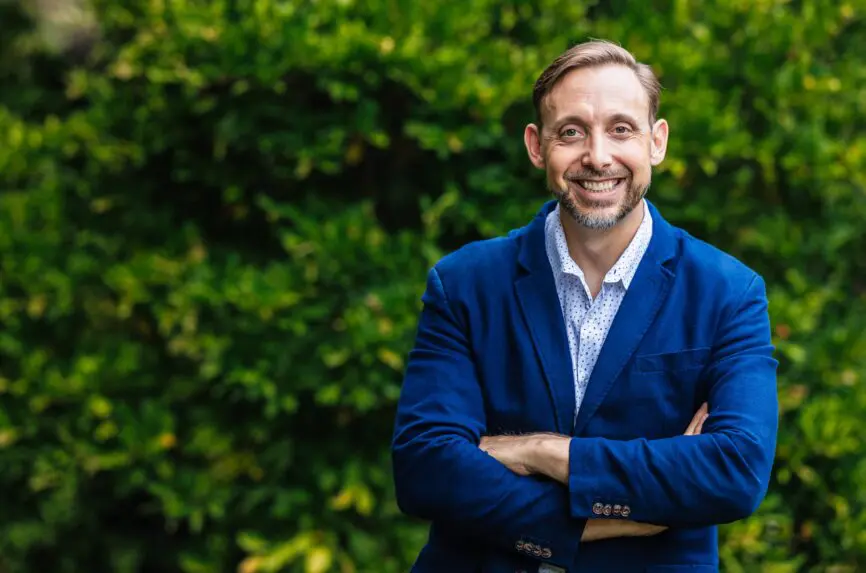
Travis N. Rieder, PhD, is an associate research professor at the Johns Hopkins Berman Institute of Bioethics, where he directs the Master of Bioethics degree program. He is a Hastings Center Fellow whose work on catastrophes has spanned from the global to his personal struggle with opioid dependence following medical treatment. “It would be hard to imagine writing good biomedical ethics scholarship if you had never really experienced medicine in some way,” he told Vardit Ravitsky. “I didn’t understand so much of it before I saw it from the inside.” Their conversation has been edited for clarity.
Vardit: Your first book is about pain and opioids (In Pain: A Bioethicist’s Personal Struggle with Opioids) and your second is about climate and large-scale catastrophes (Catastrophe Ethics: How to Choose Well in a World of Tough Choices). How did you get from one to the other?
Travis: The newest book on catastrophe ethics is actually the older project. I was working on a moral philosophy dissertation at Georgetown and I got very angsty about not doing practical real-world stuff. I was horrified by climate change and how bad things were and became interested in solving large-scale, structural, catastrophic threats. During that time, I was in a motorcycle accident. I almost lost my foot. I had six major reconstructive surgeries.
That was a life-changing experience. I learned about pain, opioids, and societal attitudes toward drugs. I set aside all my long-term projects and studied the epidemiology of opioids, the overdose epidemic, pain and addiction, and neurobiology. I did a TED talk on the agony of opioid withdrawal and what doctors should tell patients. And I wrote the book on pain. Then, I finally carved out time to get back to the original project of climate change.
Vardit: That’s an incredible journey! As bioethicists, we often deal with our own life experiences by launching into research. It was the same for me. I was pregnant at 40 and had a high-risk prenatal result. I was frustrated with how the system worked for women, and that launched a 12-year research program about the ethics of genetic testing in pregnancy. We cope with things by studying them, don’t we?
Travis: Absolutely. I’d never had a medical trauma. I’d never been hospitalized. For bioethicists, our field of study, a big chunk of it, is the healthcare system. Medicine is our own fragility. This was the first time I viscerally understood my own vulnerability, my dependence on healthcare and medicine.
It would be hard to imagine writing good biomedical ethics scholarship if you had never really experienced medicine in some way. I didn’t understand so much of it before I saw it from the inside.
Vardit: Shortly after the United Healthcare CEO was shot and killed in Midtown Manhattan last year, you had a guest essay in the New York Times about the ethics of the public response. Tell me what you learned from this event, and this notion of the messy middle of difficult moral topics.
Travis: I write for the public a lot. An editor at the New York Times reached out and said, “This feels really weird to a lot of us at the New York Times because Luigi Mangione [the shooter] is being turned into a folk hero for committing this murder. A distressingly large percentage of the population is praising him for his act, which seems to imply that it’s a good thing. So, as an ethicist, do you have anything to say about that?”
It boils down to our lack of ability to deal with nuance. When we come to a divisive issue, we immediately divide into camps. We drive each other as far into the other corner as possible.
Vardit: You’re talking to an Israeli who’s dealing with this all the time! Every word you say resonates with me on a visceral level.
Travis: We can identify with somebody’s hurt or justified outrage at an unjust system, but that does not automatically mean that we condone whatever they do as a result of that outrage. Luigi Mangione killed someone in cold blood. If anything’s true in ethics, it is that murder is one of the bad things. If we can’t agree on that, what could we possibly agree on? I wanted to articulate that even when we find certain forms of outrage justifiable, we should hold on to that view. That was the nuance. Honestly, much of my career is looking at some topic and shouting, “Nuance, people! Nuance.”
Vardit: What’s your passion other than academic research?
Travis: Rock climbing. It is my favorite thing to do in the world, outside of being with my family. It’s the best, most restorative thing that I can imagine doing.

Vardit: I link that back to your reconstructive surgeries. It’s quite mind blowing that you can do that.
Travis: A dear friend told me I should try rock climbing. Climbing is adaptive; there are amputees who rock climb. They use different strategies to solve problems. In climbing, it’s described as problems on the wall. Every year I gain just a little bit more mobility, a little bit more desensitization.
Vardit: Which ties back to everything you said about lived experience. What advice do you have for someone who aspires to a career in bioethics?
Travis: I conceive of bioethics as inherently multidisciplinary. You need other people because you’re not going to be an expert in all things. You’re going to work on projects with people who know way more about a part of your project than you do, which can cause imposter syndrome. All my work on pain and opioids I do in collaboration with pain and addiction medicine doctors and drug epidemiologists. It’s a little intimidating. My advice is: Come to grips with the deeply multidisciplinary aspect of a project.
Vardit: I find the imposter syndrome particularly fascinating. I’ve learned to live with the discomfort. Thank you so much, Travis.