Hastings Center News
Bioethics Chats: Quill R Kukla
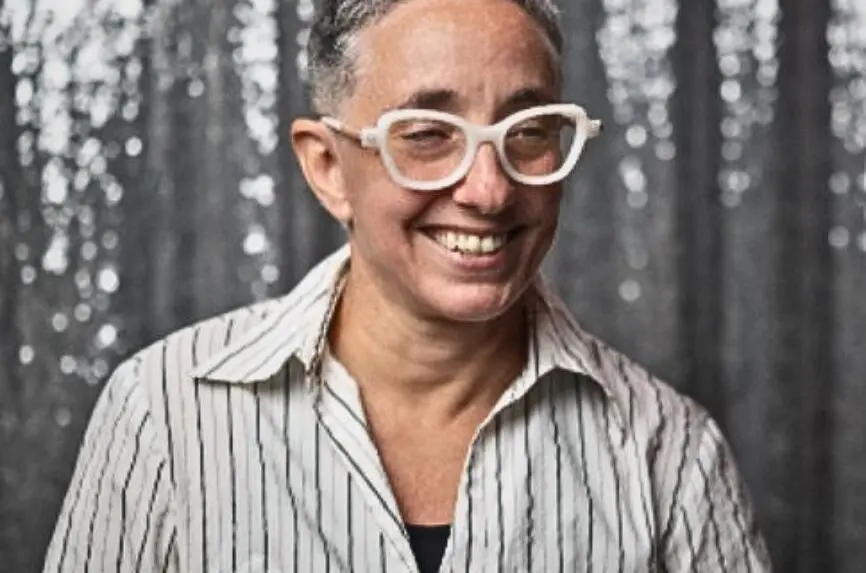
Quill R Kukla, PhD, is a professor of philosophy and disability studies at Georgetown University and is a Hastings Center Fellow. Kukla’s interests are far-ranging, including good sex, the topic of their latest book. Kukla chatted with Vardit Ravitsky about the book, global biopolitical crises, and why the world desperately needs bioethicists now. The chat has been edited for clarity.
Your new book has an intriguing title: Sex Beyond “Yes”: Pleasure and Agency for Everyone. What motivated you to write it?
I realized that almost all our discussions about sex, from every political direction, both scholarly and public, were focused on how sex could go wrong, how common bad and unethical sex is, how patriarchy encourages bad sex, and how to avoid rape and sexual harm. I wanted to write a book about good sex — sex that not only manages to avoid being unethical, but that is a joint activity built around pleasure, expressive and respectful of everyone’s agency, and fulfilling and worthwhile for everyone. Society’s focus on a blunt version of consent, where it is the job of one person who is asking for sex to get a “yes” from the other person, portrays ethical sex as deeply asymmetrical, and doesn’t give us any guidance for having good sex apart from merely avoiding rape.
I also wanted to write a book that genuinely spoke to the agency, pleasures, and experiences of all kinds of sexual subjects. In my book, queer sex, kinky sex, and sex for trans people, disabled people, old people, fat people, and nonmonogamous people are just as centered as is traditional sex between heterosexual monogamous couples. I tried to draw on the sexual wisdom of alternative sex communities such as queer and kinky communities, who have often thought and talked deeply about sexual agency because they cannot just slide unreflectively into the given heterocentric, patriarchal scripts provided by our culture.
Finally, I wanted to explore how sexual agency and pleasure can be socially scaffolded or undermined. I was interested in how physical spaces, educational and medical and legal institutions, economic systems, and cultural norms can enable good sex or encourage bad sex.
This book is aimed at a general audience, and you have been doing more public writing lately. What impact has that had on your life and career?
It has been extremely gratifying to see my writing have concrete effects and reach a broader audience. I am in contact with sex educators, therapists, folks working in harm reduction and safer sex, and community groups who are developing and protecting spaces for queer and trans sexual agency. I’ve started doing workshops and collaborations with these nonacademic partners, and these are very gratifying.
What are your current projects?
One project is my ongoing philosophical exploration of our concepts of health, disease, and disability and, in particular, the benefits and harms of bringing various kinds of conditions that are not traditional health conditions, such as neurodiversity, fatness, and gender identity, under the umbrella of health or disability.
You also recently published a book on urban space and city living, after doing a mid-career graduate degree in geography. Is there a connection between that work and your work in bioethics?
Yes, absolutely! I am drawing on my interests and expertise in place and territory, health, and agency, to explore how some marginalized groups, such as sex workers, unhoused people, and undocumented residents, have distinctively precarious access to territories of their own – that is, places where they experience themselves as and function as competent insiders, with agency and local authority. When they do have territory, these territories may be dangerous, under-resourced, and highly limited in the opportunities they provide.
I want to argue that our access to territory can support or undermine our health and our ability to protect our health. Consider, for example, red light districts and gang territories, which might serve as places where sex workers and gang members function as insiders with some authority. This authority might be very precarious, though, and these spaces might be especially dangerous, vulnerable, and perhaps governed by norms that put people at risk and render them unable to seek various kinds of support for their health, safety, and well-being.
If I am right about all this, then there are essentially spatial reasons why members of marginalized groups face distinctive health challenges and risks – challenges and risks that cannot be reduced to poorer health care or physiologically toxic environments. These health inequalities need to be addressed at the level of placemaking, territorial enfranchisement, urban planning, and place security.
You are based temporarily in Germany for research purposes. Where are you and what are you doing?
Right now, I am a senior research fellow at the SOCRATES (Social Credibility and Trustworthiness of Expert Knowledge and Science-Based Information) Centre for Advanced Studies at Leibniz University Hannover. I am working on the pragmatic and rhetorical structure of science communication, especially medical and public health communication. I am especially interested in how we communicate risk and uncertainty, and in how science communication builds or undermines trust and epistemic authority. Lately, I have been studying how the material and aesthetic dimensions of expert communication — where it happens, with what staging and choreography — shape how it is received and integrated into communal understandings of scientific and medical knowledge and expertise.
What do you think are the top challenges in bioethics today?
I can no longer meaningfully separate bioethics from biopolitics. We are facing existential threats that are saturated by ethical issues. We are in the midst of multiple global wars that are killing civilians, leaving children orphaned, destroying basic infrastructure supporting health and well-being, and causing widespread precarity and trauma. These wars generate bioethical issues that cannot be separated from existential and political issues. Similarly, we are on the brink of climate collapse, which will leave billions of already-vulnerable people without homes, food, safety, or basic health care access, and which may leave our children with no sustainable future lives. Meanwhile, AI is penetrating all aspects of our lives, and we have no idea what the consequences will be for our public or personal health and well-being.
Do you think that recent political changes in the United States have generated biopolitical crises?
I do indeed, but I also think that what is happening in the United States cannot be extricated from our global situation. The assaults in the United States on immunization and on evidence-based medical care, for instance, risk causing epidemics and pandemics that can quickly become global crises. The fundamental assaults in the United States on rights of bodily autonomy and integrity — rolling back abortion rights and gender-based care and reinstating conversion therapy, for instance — are parts of a larger global pattern of the corrosion our bodily privacy and self-determination.
What advice do you have for early-career aspiring bioethicists?
We are at a moment of global upheaval. Bioethics will be too niche and abstract to survive if it isn’t directly embedded in larger political questions and issues. The world desperately needs bioethicists to find an authentic way of caring for the world in the face of multiple existential emergencies threatening our health and well-being.
These are heavy issues. What do you do for fun these days?
I have been an amateur boxer and powerlifter for a long time and I’m training for a boxing match this fall. I really enjoy immersing myself in the local punk and techno scenes in Berlin. I am trying to make time to write fiction and nonfiction literary essays that are not just extensions of my academic work. It’s also wonderful to be in Europe where it’s so easy to travel and explore new cities, which is always my very favorite thing to do. Nothing makes me as happy as setting out on foot to explore a new city for the whole day, just walking through neighborhoods.