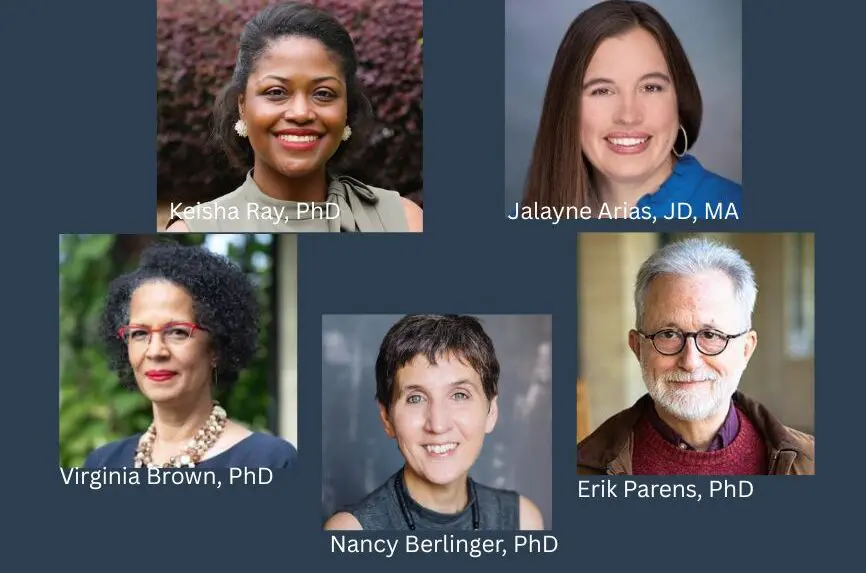
Sadler Scholars Team
Advisors and mentors
Jalayne Arias, JD, MA, is an associate professor of Health Policy & Behavioral Sciences in the School of Public Health at Georgia State University. Her research harnesses training in law and ethics to evaluate critical challenges associated with Alzheimer’s disease and related dementias (ADRD) and aging. Professor Arias completed the Cleveland Fellowship in Advanced Bioethics (Cleveland Clinic, 2011-2013) and an Atlantic Fellowship for Equity in Brain Health at the Global Brain Health Institute (GBHI) (2016-2018). Her research has been funded through grants from the National Institutes of Health, the Alzheimer’s Association, the Hellman Foundation, and the Aging Research and Criminal Health Network.
Professor Keisha Ray received her PhD in philosophy from the University of Utah. She is currently a tenured Associate Professor and holds the John P. McGovern, MD Professorship of Oslerian Medicine at the McGovern Center for Humanities & Ethics at UT Health Houston. Most of Dr. Ray’s work focuses on the effects of racism on Black people’s health, highlighting Black people’s own stories, and the sociopolitical implications of biomedical enhancement. And based on her expertise, Dr. Ray is frequently called upon as a bioethics expert for popular news sources. Dr. Ray is also the author of the book “Black Health: The Social, Political, and Cultural Determinants of Black People’s Health” with Oxford University Press.
Mentors
Virginia A. Brown, MA, PhD, is a research scholar in social justice and population health. She joined The Hastings Center in September 2023 from the University of Texas at Austin Dell Medical School where she served as an assistant professor in the department of population health in the division of Community Engagement and Health Equity and as the associate director of the Liberal Arts Honors program in the College of Liberal Arts. She brings to The Hastings Center expertise on protecting the autonomy of persons living with serious mental illness using psychiatric advance directives, and she continues her research by expanding her inquiry to include attending to the question, “What does bioethics owe justice?”
Erik Parens, PhD, is a Senior Research Scholar emeritus at The Hastings Center for Bioethics. He received his PhD from the University of Chicago’s interdisciplinary program in the humanities, The Committee on Social Thought. In the mid-1990s he led, with the pioneering disability rights activist and bioethicist Adrienne Asch, an ELSI-funded project that sympathetically grappled with the disability critique of prenatal genetic testing. In the early 2000s, he led an ELSI-funded project which examined the ethical and social implications of behavioral genetics. In 2010 he joined Paul Appelbaum to create the Columbia-Hastings Center for Research on the Ethical, Legal & Social Implications of Psychiatric, Neurologic & Behavioral Genetics. He recently finished a Robert Wood Johnson Foundation-funded project that he co-led with bioethicist Michel Meyer, focusing on the ethics of ELSI research into “social” phenotypes as complex as educational attainment.
Director and mentor
Nancy Berlinger, PhD, MDiv., is a senior research scholar at The Hastings Center for Bioethics. Her interdisciplinary humanities research focuses on ethical and social challenges arising from population aging, including AI, dementia care, family caregiving, housing choice, and how cultural and policy narratives shape experiences of aging. She is first author of the revised and expanded second edition of The Hastings Center Guidelines for Decisions on Life-Sustaining Treatment and Care Near the End of Life (Oxford University Press, 2013) and of the forthcoming third edition, and the author of After Harm: Medical Error and the Ethics of Forgiveness (Johns Hopkins, 2005) and Are Workarounds Ethical? Managing Moral Problems in Healthcare Systems (Oxford, 2016). She founded the Sadler Scholars program in 2021 and also directs the SNF Scholars program for early-career bioethics researchers from low- and middle-income countries.